
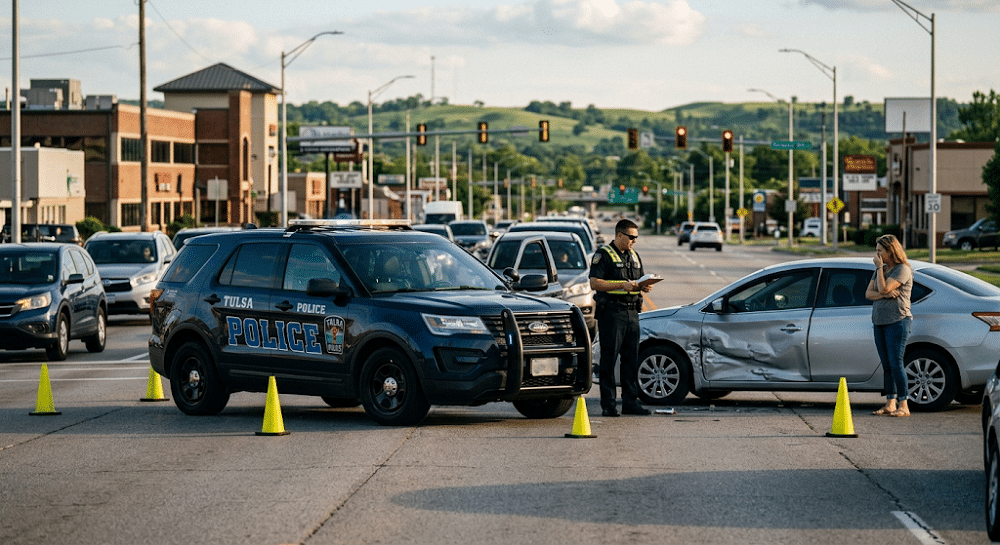
Under Oklahoma law, sharing partial responsibility for an auto collision does not automatically stop you from recovering compensation. Oklahoma operates under a modified comparative fault standard, often called the 51% rule. This means an injured driver can recover damages as long as their share of fault is 50% or less. However, if your level of responsibility reaches or exceeds 51%, state law completely bars you from receiving financial recovery from the other party.
Understanding these legal boundaries is critical when navigating complex car wreck claims throughout the region. Insurance companies frequently attempt to push a driver’s assigned blame over that threshold to avoid paying out settlements entirely. If you were involved in a collision in Green Country, consulting an experienced car wreck claims advocate at Benedict Law in Tulsa, OK can ensure your rights stay protected against unfair fault allocations.
Vital Takeaways
The key concepts below summarize how shared responsibility affects injury recovery under state statutes:
- The Barring Threshold: You must be 50% or less at fault to collect financial compensation after a crash.
- Proportional Reductions: Financial recoveries drop directly in proportion to your assigned percentage of responsibility.
- Insurance Tactics: Adjusters often try to shift blame onto victims to cross the 51% limit and deny payouts.
- Crucial Evidence: Police reports, physical crash site data, and witness accounts help fight inflated fault claims.
- Protected Damages: Medical bills, missed paychecks, and non-economic losses remain eligible for recovery when fault stays below the legal limit.
How Modified Comparative Negligence Works in Oklahoma
When two or more motor vehicles collide on roads like I-44 or the Broken Arrow Expressway, local authorities and insurance adjusters evaluate the scene to assign blame. Instead of choosing one single person who is entirely responsible, state law allows fault to be split among drivers using percentages.
Your total financial recovery depends on how those percentages are calculated. If a judge or jury determines your losses equal $100,000, your final check is directly reduced by your share of blame. For instance, if you were speeding slightly but another driver ran a red light, a court might determine you hold 20% responsibility while the other motorist carries 80%. In that scenario, your overall award is reduced by 20%, resulting in an $80,000 recovery.
The Major Threshold: Comparing Recovery Scenarios
The distinction between being 50% at fault and 51% at fault is the difference between receiving a substantial payout and getting nothing at all. This strict cutoff creates high stakes during settlement discussions and legal proceedings.
| Assigned Fault Percentage | Legal Status Under Oklahoma Law | Impact on $50,000 Claim |
| 0% Fault | Fully eligible for recovery | Receives full $50,000 |
| 25% Fault | Eligible under the 51% rule | Receives $37,500 (reduced by 25%) |
| 50% Fault | Maximum fault allowed for recovery | Receives $25,000 (reduced by 50%) |
| 51% or Greater | Barred from financial recovery | Receives $0 |
Because of this cutoff, insurance representatives often attempt to assign just enough extra blame to push an injured motorist over the 50% mark. They may point to minor details, such as a slight delay in braking or a minor turn signal omission, to argue that you contributed substantially to the crash.
Protecting Your Right to Financial Recovery
To avoid having your compensation slashed or denied entirely, gathering clear physical evidence immediately after a collision is crucial. When evaluating contested vehicle accidents, attorneys look at multiple sources of proof to establish exact responsibilities:
- Official collision reports compiled by responding police officers.
- Photos showing vehicle point-of-impact damage, skid marks, and road hazards.
- Surveillance camera footage from nearby businesses or traffic signals.
- Statements taken from objective eyewitnesses at the scene.
- Reconstruction reports generated by professional accident specialists.
Building a strong evidence file helps counter aggressive insurer strategies that try to inflate your fault share. A skilled car wreck attorney tulsa ok can handle communications with adjusters, challenge questionable statements, and ensure medical records accurately reflect the full extent of your severe personal injuries.
Frequently Asked Questions
Can I still receive compensation if I was partly to blame for a auto accident?
Yes, as long as your assigned responsibility remains at 50% or below. Your final payout will simply be reduced by the specific percentage of fault assigned to you.
What happens if the insurance adjuster claims I am 55% at fault?
If the insurance company successfully assigns you 55% responsibility, Oklahoma law prevents you from collecting any compensation. You can challenge this decision by presenting clear physical evidence alongside a legal representative.
Which types of damages can I recover under the 51% rule?
You can seek compensation for both economic and non-economic losses, including emergency room bills, ongoing therapy costs, lost income, vehicle repairs, and physical pain and suffering.
How do adjusters decide each driver’s percentage of blame?
Adjusters analyze police accident reports, driver statements, physical property damage, road conditions, and state traffic codes to reconstruct the sequence of events and assign percentage values.
Navigating the nuances of local negligence rules can feel overwhelming while recovering from a serious collision. If an insurance provider is attempting to shift blame onto you or reduce your financial settlement, turn to trusted local advocates. Contact Benedict Law in Tulsa, OK today to discuss your car wreck claims and protect your right to full financial recovery.